Turning a Fragile Pricing Engine into a Scalable System
NDA Protected60-Second Summary (TL;DR)
The outcome: Delivered a redesigned enterprise pricing system under a tight, non-negotiable deadline without increasing delivery or compliance risk. Reduced pricing confusion and errors by making complex logic transparent and explainable. Aligned design, research, product, and engineering around a single delivery plan.
Why it mattered: Leadership needed confidence that a fragile legacy pricing workflow could be replaced in weeks, not months. Engineering needed early clarity to avoid late-stage rework. The business needed a credible pricing story ready for high-visibility demos.
What I did:
- Led design while running parallel design and research with the lead researcher, aligning daily as questions and concepts evolved.
- Designed ahead of finalized research, shaping research questions in real time to meet deadlines.
- Partnered closely with product owners and developers to set weekly expectations and delivery options.
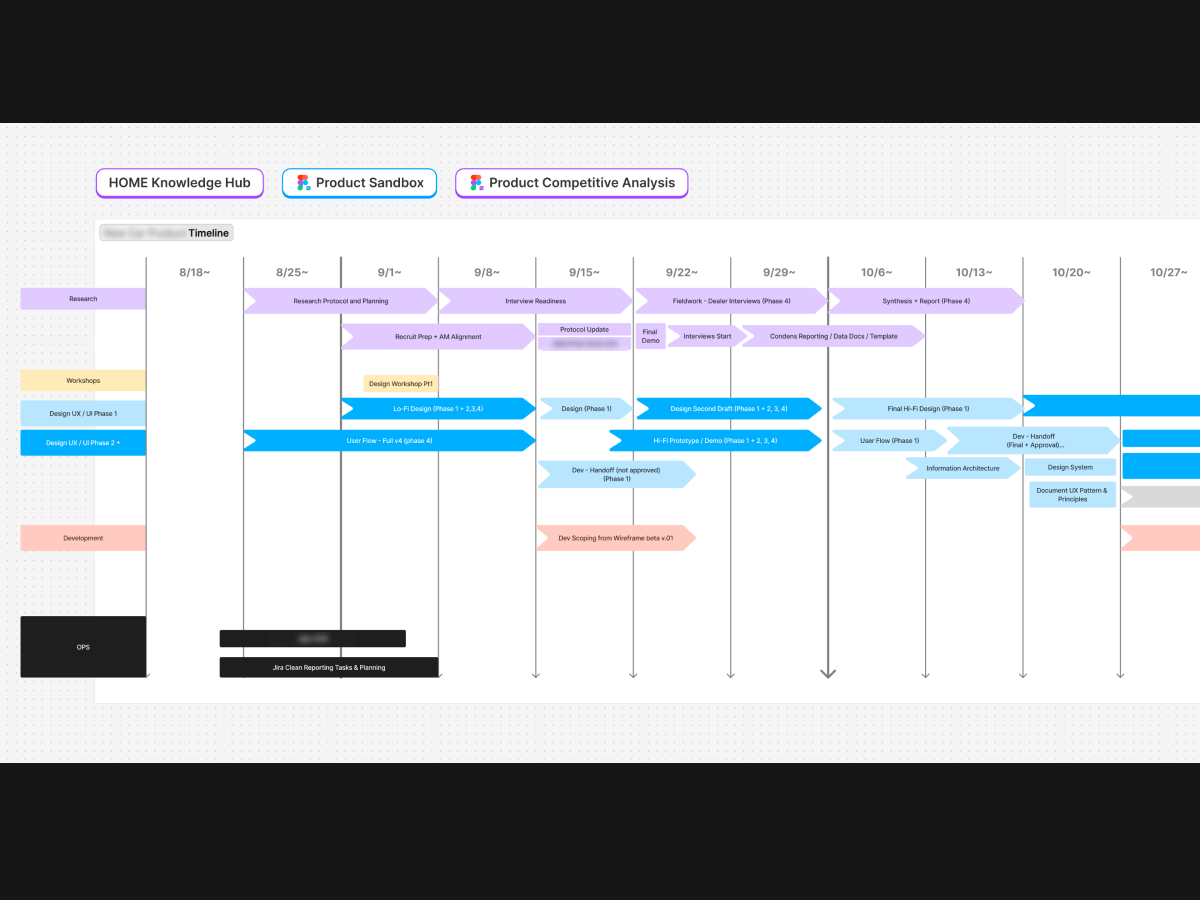
- Created a shared FigJam timeline to align leadership, product, research, design, and engineering.
Proof: Research validated core pricing concepts despite compressed timelines. Engineering began implementation earlier with fewer surprises. The timeline became the source of truth for scope and sequencing.
Timeframe: Late August – Mid October 2025, with continued design support during development due to build constraints.
External Link (After April 2026): NDA — not publicly available
Overview
Primary Impact:
Stabilized a fragile pricing workflow into a scalable, auditable system while meeting a deadline the organization had previously failed to hit.
Secondary Impacts:
- Reduced dealer pricing errors and compliance risk through transparent rebate logic.
- Enabled engineering to deliver predictably by surfacing scope, tradeoffs, and constraints early.
- Established a repeatable delivery model for complex, high-risk systems.
Role:
Lead Product Designer with end-to-end ownership of system design, UX architecture, and delivery alignment.
Scope:
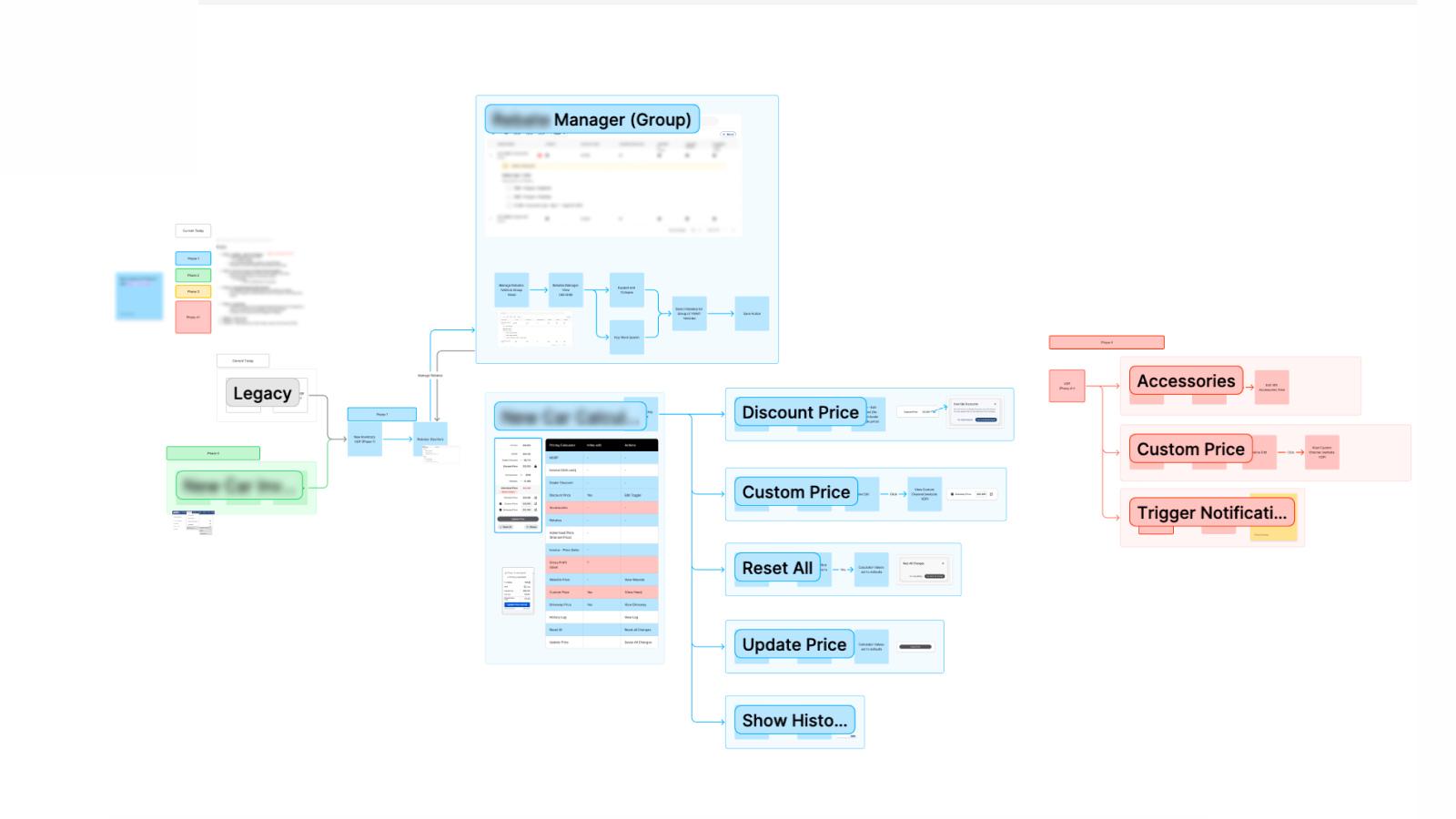
System-level redesign spanning pricing logic, rebate management, and a new VDP (Vehicle Display Page) foundation, across design, research, product, and engineering.
Why This Is Hard:
The work required redesigning a critical pricing system while requirements arrived late, scope shifted, legacy architecture resisted change, and the delivery timeline was fixed.
Why Leadership Needed Proof
- A non-movable external demo deadline created real delivery risk if the pricing system slipped or failed.
- The legacy pricing workflow was fragile and poorly understood, increasing the chance of compliance errors if changes were rushed.
- Engineering needed early clarity to scope complex logic, but design and research were still evolving.
- Leadership had seen previous pricing efforts stall due to late discovery and misaligned expectations.
What leadership needed answered:
- Can we replace a fragile pricing workflow in weeks without increasing risk?
- Can engineering start early without committing to the wrong solution?
- Is there a credible plan that aligns teams around scope, timing, and tradeoffs?
The Real Problem (Not the Obvious One)
What leadership thought the problem was:
- Dealers were struggling to apply rebates correctly.
- Pricing errors were creating compliance risk.
- The system needed a better rebate management UI.
What was missing from that framing:
- Rebate errors were a symptom, not the root cause.
- There was no centralized, controllable source of truth for rebates across store and vehicle levels.
- Incremental fixes had already made the legacy system fragile, risky to change, and understood by only a few people.
The real problem I identified:
- The organization lacked a scalable, transparent rebate system and a delivery approach that could handle its complexity.
- Scope volatility, unclear ownership, and fragmented documentation were compounding technical risk.
- Without intervention, the new system risked repeating the same fragility as the legacy one.
What would have broken if nothing changed:
- The project would miss its delivery window due to late discovery and shifting requirements.
- Engineering would be forced into reactive fixes, increasing long-term maintenance and compliance risk.
- Knowledge would concentrate in a few individuals, recreating the same bottlenecks that stalled past pricing efforts.
The actual need:
- A centralized, accurate, and auditable rebate system that dealers could control with confidence.
- A delivery model that surfaced unknowns early, absorbed scope change deliberately, and avoided incremental patchwork.
- Clear timelines, shared documentation, and explicit tradeoffs to prevent silent failure.
Operating Model We Proved
Strategy:
Run design and research in parallel to surface unknowns early, while using a shared timeline and explicit tradeoffs to keep delivery predictable under a fixed deadline.
Mental model:
- Design leads direction and scope framing early to unblock engineering.
- Research validates and refines in-flight decisions rather than waiting for a “ready” state.
- Product and engineering receive weekly options, not surprises.
- One shared plan replaces fragmented artifacts as the source of truth.
What this replaced:
- Sequential handoffs that delayed discovery until it was too late to course-correct.
- Unlinked documents and informal updates that hid scope changes.
- Late-stage validation that increased rework and delivery risk.
How it worked in practice:
- Produced a wireframe and scoping draft within two weeks to anchor feasibility and timeline discussions.
- Partnered daily with the lead researcher to shape research questions as designs evolved.
- Set weekly expectation checkpoints with product owners and developers, presenting clear delivery options and tradeoffs.
- Created a FigJam master timeline to align leadership, product, research, design, and engineering around scope, sequencing, and constraints.
What changed immediately when adopted:
- Engineering could start scoping and implementation earlier with clearer assumptions.
- Research validated the highest-risk decisions despite compressed timelines.
- Scope creep became visible and deliberate rather than implicit.
- Leadership gained confidence through a single, credible delivery plan.
The 3 Decisions That Drove the Outcome
Decision 1: Lock a Two-Week Scoping Draft Before Research Was Ready
Problem it solved:
Engineering needed clarity immediately to meet a non-movable deadline. Waiting for fully validated research would have blocked scoping and guaranteed a slip.
Options considered:
- Wait for research validation before sharing designs
- Share a rough, low-fidelity preview to unblock engineering
Tradeoff accepted:
Gave up the certainty of a fully research-validated blueprint in favor of speed and early alignment.
Decision:
Delivered a rough wireframe and scoping draft within two weeks as a preview handoff so engineering could begin API and logic planning in parallel.
Why this worked:
Early visibility surfaced unknowns while changes were still inexpensive.
Proof:
Developers reported reduced churn and fewer late-stage surprises, and final hi-fi designs were still delivered ahead of schedule.
Decision 2: Replace the Legacy Pricing Workflow Instead of Incremental Fixes
Problem it solved:
The existing pricing workflow was fragile, hard to reason about, and risky to extend. Incremental fixes had already created technical debt and institutional knowledge silos.
Options considered:
- Patch the legacy workflow to support new pricing logic
- Re-architect the pricing experience around a new, centralized system
Tradeoff accepted:
Temporarily lost feature parity with parts of the legacy workflow.
Decision:
Pivoted to a modern pricing architecture that could support transparent logic, live updates, and future expansion without compounding risk.
Why this worked:
A clean foundation reduced cognitive load for users and long-term technical debt for engineering.
Proof:
Dealers immediately reported improved clarity and trust in pricing decisions.
Decision 3: Use Phased Scope to Protect the MVP While Designing the Full System
Problem it solved:
The full pricing vision was too large to ship safely in one pass under the given timeline.
Options considered:
- Deliver the complete system in a single release
- Phase delivery while designing the full system upfront
Tradeoff accepted:
Delayed advanced features in favor of a stable and predictable MVP.
Decision:
Designed multiple future phases but strictly limited Phase 1 to the core pricing and rebate logic needed to succeed.
Why this worked:
Clear boundaries protected delivery while keeping the system future-proof.
Proof:
Engineering cited the phased structure as improving predictability and reducing confusion, and the model was reused on later projects.
Evidence and Validation
Delivery and execution signals:
- Engineering began scoping and implementation earlier than usual due to the two-week preview handoff.
- Design handoff landed ahead of schedule despite parallel research and shifting requirements.
- Fewer late-stage questions and rework compared to previous pricing initiatives.
Research and user validation:
- Core pricing and rebate concepts validated with dealers despite compressed timelines.
- Dealers consistently understood pricing logic, stacking rules, and control boundaries without additional explanation.
- Feedback confirmed increased trust driven by transparency rather than added features.
Behavioral and organizational signals:
- The FigJam timeline became the shared source of truth across design, research, product, engineering, and leadership.
- Scope changes were discussed explicitly and intentionally, rather than discovered during build.
- Engineering referenced the phased structure as improving predictability and reducing delivery risk.
What would not have happened otherwise:
- Engineering would have waited on finalized designs, compressing build time and increasing risk.
- Scope creep would have remained implicit, increasing the chance of missed deadlines.
- The new system would likely have repeated the same fragility and knowledge silos as the legacy workflow.
Constraints That Shaped the Work
Timeline pressure:
- The project operated under an extremely compressed timeline that no other design team in the organization had previously delivered against with similar scope and quality.
- Requirements were finalized late, leaving less than two months to scope, research, design, validate, and support development.
- A non-movable external demo deadline eliminated the option to slip or partially deliver.
Legacy system constraints:
- Initial work was constrained by the existing pricing and VDP (vehicle display page) architecture, which was fragile and difficult to extend safely.
- Midway through the project, it became clear that continuing within the legacy structure would recreate the same long-term risks.
- This forced a deliberate pivot to designing a new VDP foundation from the ground up.
Design system and architectural limits:
- The new VDP needed to leverage existing design system patterns to remain buildable within the timeline.
- Prior system patterns I had established enabled a faster pivot without sacrificing consistency or quality.
- New components had to be flexible enough to support future phases without expanding Phase 1 scope.
Phasing and scope constraints:
- Phase 1 required a tightly scoped MVP to ensure delivery, even though the full system vision extended across multiple future phases.
- Research and validation had to cover Phases 1 through 4 to avoid downstream rework and blind spots.
- Advanced features were intentionally designed and tested, but excluded from the initial release.
Organizational and resource constraints:
- Engineering capacity was limited and partially shared across teams.
- Design needed to absorb uncertainty and adjust sequencing to keep development unblocked.
- Clear tradeoffs and expectation-setting were required to prevent silent scope expansion.
Reflection (Forward-Looking)
Capability unlocked:
- Proved I can lead system-level design delivery under extreme constraint without sacrificing clarity or trust.
- Demonstrated that parallel design and research can be run safely when paired with explicit timelines, tradeoffs, and shared artifacts.
- Established a repeatable model for aligning design, research, product, and engineering around complex, high-risk systems.
How this changed my approach:
- I now treat operating models as a first-class design decision, not a background process.
- I prioritize early scoping artifacts to surface risk while changes are still inexpensive.
- I design full systems upfront, even when delivery must be phased, to avoid recreating legacy fragility.
- I am more explicit about tradeoffs and constraints to prevent silent failure.
What I look for next:
- Problems where system complexity, organizational pressure, and delivery risk intersect.
- Opportunities to replace brittle legacy workflows with scalable foundations.
- Work that requires aligning teams through clarity, not heroics.
- Challenges where design leadership directly influences execution quality and long-term system health.