DS-Bridge: AI-Enabled Workflow
60-Second Summary (TL;DR)
The outcome: Reduced the path from product idea to production-ready UI from months to days by replacing static design documentation with a shared, executable system.
Why it mattered: The organization needed proof that design systems and AI-assisted workflows could scale securely and deliver real value beyond Figma artifacts.
What I did: Designed and validated an AI-enabled operating model that lets non-technical designers plan, build, validate, and document real components directly in code.
Proof: A junior designer with no coding background shipped a production component in under a week; the system produced 5 components, 95 tests, and a live documentation site adopted as the source of truth.
Timeframe: December 2025, 2 weeks from idea to full site
External POC Link: DS-Bridge
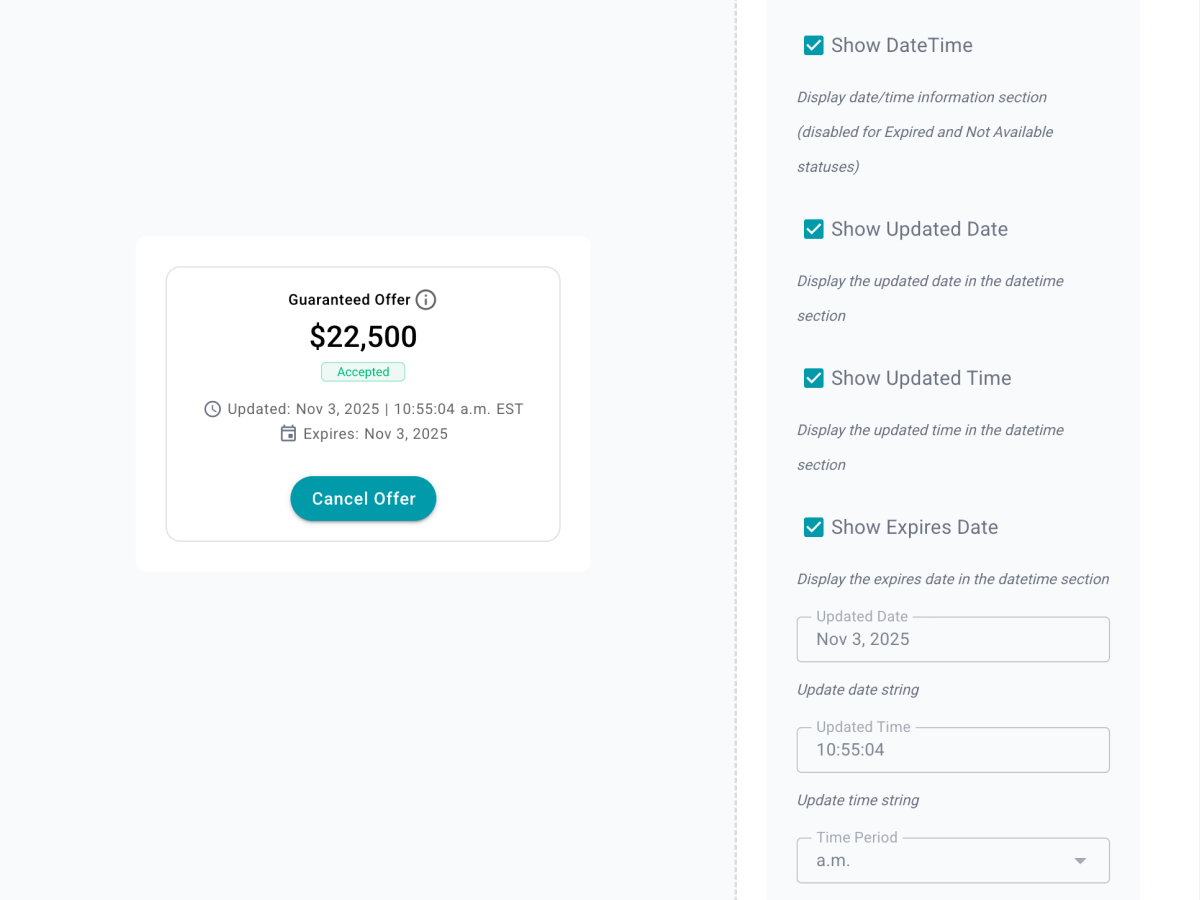
Overview
Primary Impact:
Turned months of design–development handoff into days by letting designers validate production-ready UI directly in code.
Secondary Impacts:
- Replaced static Figma documentation with a living, executable source of truth usable by designers, engineers, and product partners.
- Enabled non-technical contributors to safely build and validate real components directly in the codebase.
- Shifted engineering effort from manual translation to high-leverage refinement.
Role: AI / Systems-Focused Designer (Principal-level scope)
Scope: Company-wide whitelabel design system; design, documentation, workflow automation, and engineering integration.
Why This Is Hard: Required aligning human workflows, AI behavior, and enterprise security constraints while proving real production value, not a demo.
Why Leadership Needed Proof
This work originated from a VP of Product mandate to evaluate whether the company should continue investing in a whitelabel design system at scale. Leadership needed more than static design artifacts to justify further funding and adoption
Prior efforts relied on Figma-based components and written guidelines, which:
- Failed to drive consistent usage outside the design team
- Did not give engineering or product leaders confidence in real-world feasibility
- Required ongoing manual maintenance with unclear ownership
The core leadership question was not “can we design these components,” but:
- Can this system reduce time-to-market?
- Can it scale across teams without increasing headcount?
- Can it operate securely within enterprise AI constraints?
A traditional proof of concept would have been insufficient
- Static mocks would not surface technical constraints
- Documentation alone would not demonstrate adoption or workflow change
What leadership needed was proof of an operating model, not a visual demo:
- Evidence that designers, engineers, and product partners could work closer together
- Validation that AI-assisted workflows could produce production-ready output
- Confidence that this approach could become a long-term system of record
The Real Problem (Not the Obvious One)
What leadership thought the problem was:
- Create a small set of static whitelabel components in Figma
- Show visual examples of how other brands might be supported
- Prove concept viability at a surface level
What was missing from that framing:
- No consideration for how the system would scale
- No plan for long-term maintenance or contribution
- No clear ownership model
- No assessment of time, cost, or operational overhead
- No exploration of how AI workflows could reduce effort or improve quality
The real problem I identified:
- Design systems fail not at creation, but at contribution and maintenance
- Small updates accumulate hidden cost when every change requires manual Figma work and parallel documentation
- A decentralized design system spread across multiple Figma files had no single, reliable source of truth
What would have broken if nothing changed:
- Whitelabel components would quickly drift out of sync
- Files would continue to grow bloated and underused
- Designers would absorb ongoing manual maintenance work
- Engineers and product partners would still lack a clear, shared place to reference the system
The actual need:
- A way to rapidly scale a design system that is easy to maintain
- One URL, one system, one source of truth
- A workflow that makes small changes cheap at scale
Operating Model We Proved
Strategy: Treat design and development as a continuous, shared feedback loop where real code is the validation layer, not the final step
Mental model:
- Figma is a collaborative exploration tool, not the source of truth
- Code is where interaction quality, edge cases, and constraints are validated
- AI acts as an accelerator and guardrail, not a replacement for judgment
What this replaced:
- Treating Figma as the final artifact handed off to engineering
- Writing extensive documentation before behavior was validated
- Relying on engineers to surface interaction issues late in the process
What changes immediately when adopted:
- Designers approach Figma with implementation efficiency in mind
- Components are validated through interaction, not assumption
- Design, product, and engineering align earlier around what will actually ship
The 3 Decisions That Drove the Outcome
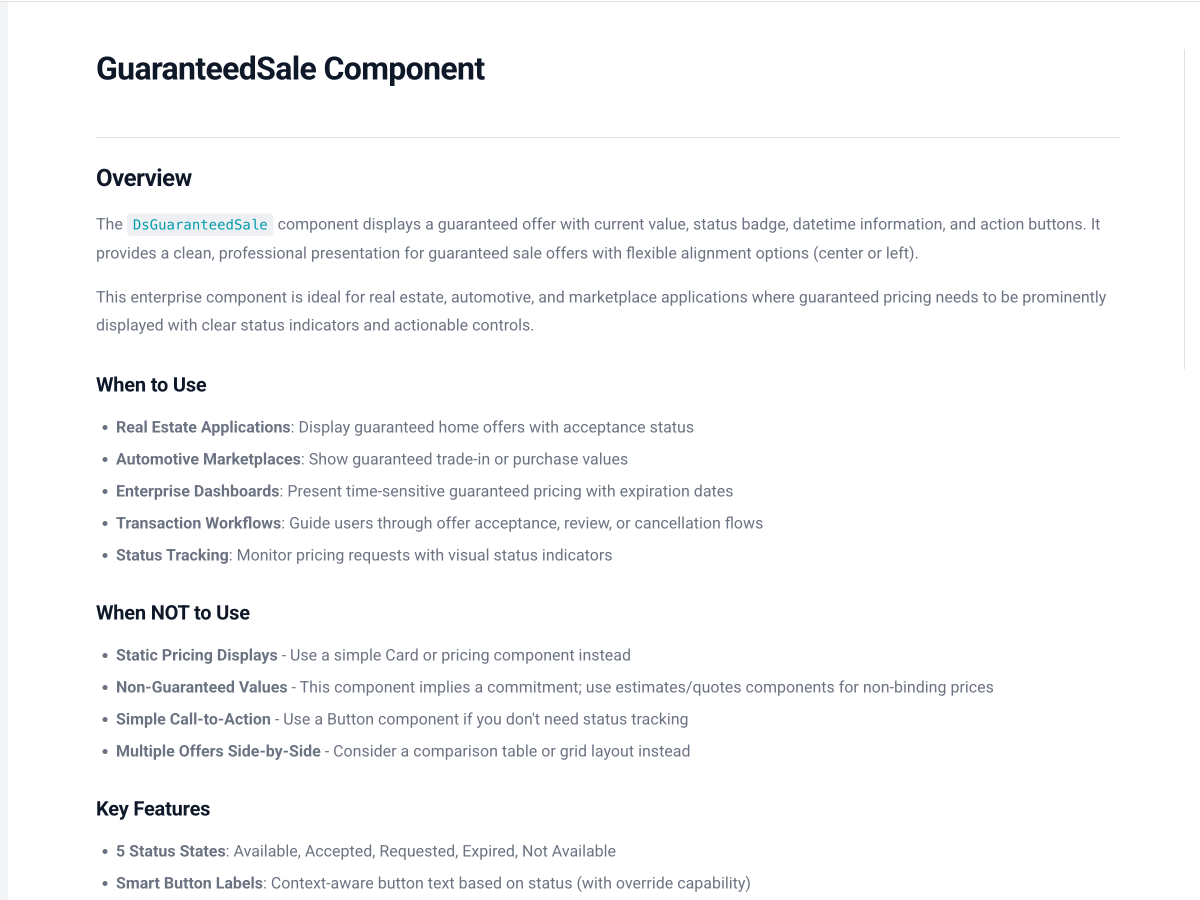
Decision 1: Component Demo-First, Two-Phase Workflow
Problem it solved: Designers and AI agents were attempting to refine component behavior and documentation simultaneously, which led to redundant work, bloated AI context, and lower-quality results
Options considered: Build component and documentation together in a single pass. Fully automate component and documentation generation. Separate component validation from documentation
Tradeoff accepted: Slower initial documentation in exchange for higher-quality components and dramatically less rework
Decision: Enforced a component demo-first workflow where designers:
- Push a real component into the codebase
- Interact with it directly to validate all states, properties, and edge cases
- Iterate between Figma and code until behavior is correct
- Enter documentation only after the component is validated
Why this worked:
- Reduced AI context window size, improving output quality
- Prevented designers from trying to solve too much at once
- Lowered cognitive load for non-technical designers
- Ensured documentation reflected real, validated behavior
Proof:
- Fewer rework cycles per component
- Faster convergence on correct behavior
- Cleaner, more accurate documentation
Decision 2: Structured Session Planning and Command-Based Guardrails
Problem it solved: Non-technical designers could easily become disoriented in the terminal, jump between tasks, or give the AI unscoped instructions that led to inefficiency, confusion, and low-quality output
Options considered: Allow free-form prompting and trust designers to self-organize. Create heavy documentation or training upfront. Encode structure directly into the workflow.
Tradeoff accepted: Reduced flexibility in exchange for clarity, focus, and repeatability
Decision: Introduced structured session planning and designer-friendly commands that:
- Forced agreement on scope before execution
- Guided designers through a predictable sequence of actions
- Automatically captured progress, decisions, and outcomes
Why this worked:
- Prevented designers from jumping around or over-scoping work
- Taught systems thinking implicitly through repeated use
- Rewarded focus with visible progress and higher-quality results
- Made contribution feel safe and approachable for non-technical users
Proof:
- Designers stayed focused within sessions
- Reduced need for corrective prompting
- Increased confidence and willingness to contribute over time
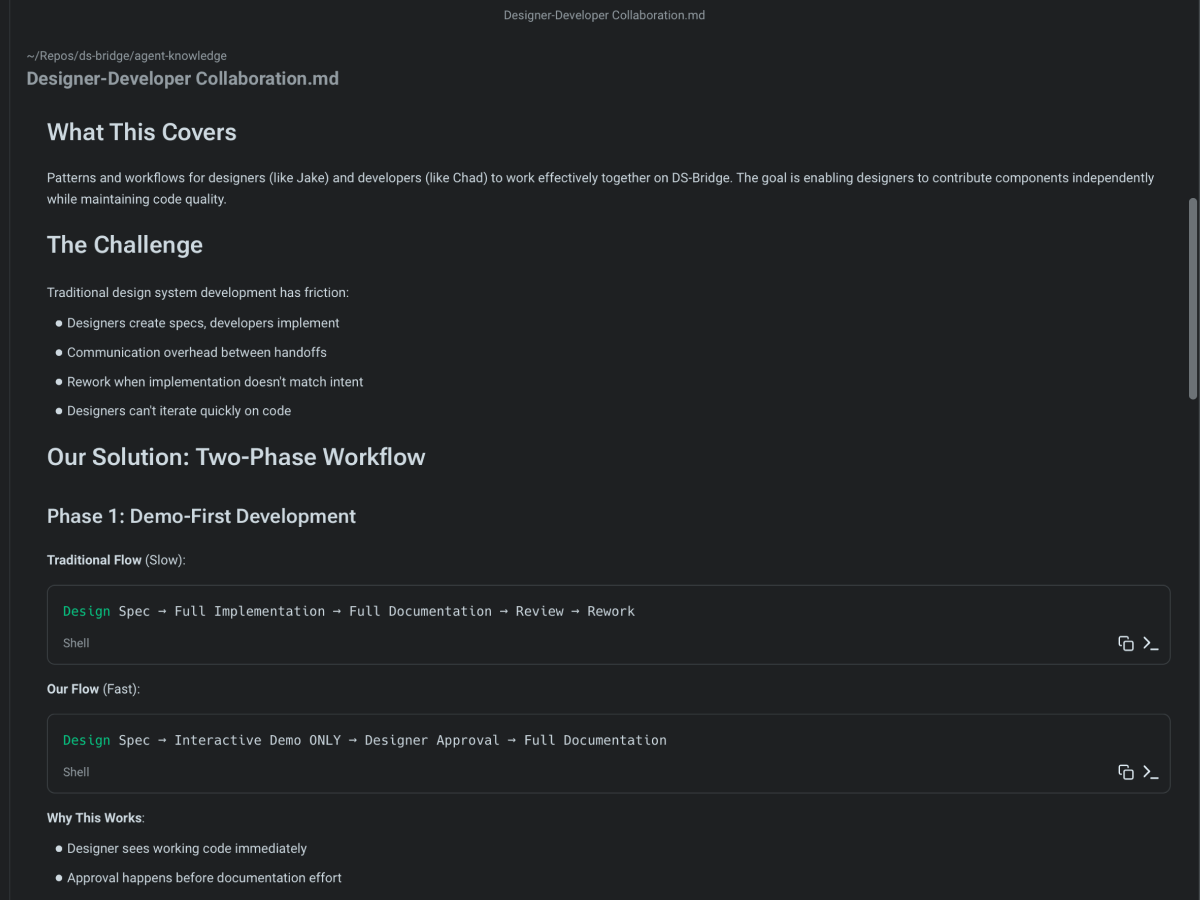
Decision 3: Let a Junior, Non-Technical Designer Own a Real Component
Problem it solved: A senior-led proof would not demonstrate scalability or cultural change; leadership needed evidence that the system worked for people without systems thinking or coding experience
Options considered: Use myself as the primary operator of the system. Pair closely with a designer and guide each step. Give a junior designer real ownership and step back.
Tradeoff accepted: Higher risk of failure in exchange for stronger proof of scalability and enablement
Decision: Chose a junior designer with no coding background and limited systems exposure and:
- Taught only the minimal set of commands needed to operate the workflow
- Explained where to view live output
- Intentionally avoided intervening in debugging, refinement, or problem-solving
Why this worked:
- Forced the system to be self-explanatory and resilient
- Created true ownership instead of dependency
- Enabled the designer to build confidence through independent problem-solving
- Revealed whether the workflow could teach systems thinking implicitly
Proof:
- The designer independently shipped and documented a real component
- Continued working on the system without supervision
- Demonstrated leadership and initiative beyond their role
Evidence and Validation
Cycle-time compression:
- Reduced idea-to-interactive validation from weeks or months to days
- Enabled same-week validation of component behavior in real code
Production proof:
- 5 whitelabel-ready components shipped
- 95 automated tests with full TypeScript coverage
- Live documentation site used as the system of record
Behavioral signals:
- A junior designer independently planned, built, debugged, and documented a component
- Continued contribution without supervision or intervention
- Increased designer confidence and ownership over the system
What would not have happened otherwise:
- Designers would not have validated interaction quality in real code
- Engineers would still translate intent instead of refining solutions
- Leadership would lack confidence in scalability beyond Figma artifacts
Constraints That Shaped the Work
Security and compliance:
- All AI workflows, tooling, and integrations required approval from internal AI engineering
- No external data leakage or unapproved tooling allowed
Organizational timing:
- Leadership availability was limited during execution
- Required proactive alignment with product owners and engineering partners
Human constraints:
- Designers had no prior terminal or coding experience
- The system needed to feel safe, guided, and reversible
Reflection (Forward-Looking)
Capability unlocked:
- Designing shared operating models where design and development converge in real code
How this changed my approach:
- I now prioritize workflow and system design over isolated deliverables
- I design for independence, ownership, and scale rather than supervision
What I look for next:
- Problems where AI can remove friction between disciplines
- Opportunities to make validation faster and decision-making cheaper
Appendix (Optional)
- Supporting artifacts
- Deep technical details
- Additional metrics or timelines
- Link to work / URL